
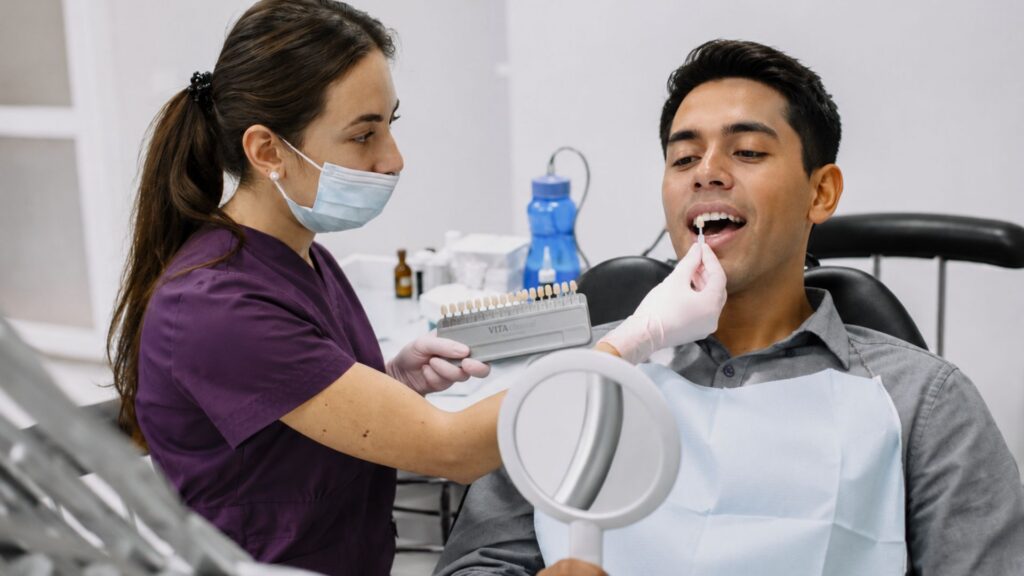
(Dentist showing a natural-looking dental crown to a patient. Buen Pastor Medical Center in Hollywood, FL — affordable dental crown.)
Dental Crown Without Insurance | Hollywood, FL
Quick Answer: At Buen Pastor Medical Center — Dental Care in Hollywood, FL, dental crowns are available with no insurance required. Treatment starts with a $70 urgent evaluation — includes consultation, exam, and a focused X-ray to diagnose the problem and provide your written flat-fee crown quote on the spot. You approve everything before we begin. Our focus is on saving your natural tooth whenever possible.
Call Our Bilingual Dental Team:
👉 📞 (954) 882-0191
👉 📅 Book Your Crown Evaluation Today
👉 Explore All Dental Services in Hollywood, FL
📍 Location:
4440 Sheridan St., Suite C, Hollywood, FL 33021
Table of Contents
- What is a dental crown and when do you need one?
- Signs your tooth needs a crown — not just a filling
- Crown vs. extraction — why saving your tooth is almost always worth it
- What happens during a dental crown procedure
- Crown materials — what we use and why it matters
- Our transparent pricing and evaluation options
- How to make your crown last longer
- FAQs about dental crowns without insurance
What Is a Dental Crown and When Do You Need One?
A dental crown — also called a cap — is a custom-made restoration that covers the entire visible portion of a damaged tooth, from the gumline up. It is cemented permanently in place and restores the tooth’s shape, size, strength, and appearance.
A crown is not a filling. It is a full-coverage solution for teeth that have been damaged beyond what a filling can repair — or teeth that need structural protection to survive the forces of daily chewing.
When is a crown necessary?
- After a root canal — a tooth that has had a root canal loses its internal blood supply and becomes brittle over time. Without a crown, a root-canal treated tooth is highly vulnerable to fracture — often catastrophically. A crown is the standard of care following root canal treatment on a molar or premolar.
- A cracked tooth — cracks in teeth are deceptively dangerous. A crack that causes pain when biting can split all the way through the tooth if left unprotected. A crown holds the tooth together and stops the crack from spreading.
- Large cavity or failing large filling — when decay or an old filling occupies more than half the tooth, there is not enough healthy structure remaining to support a new filling. A crown distributes chewing force across the entire tooth, protecting what remains.
- Severely worn teeth — teeth worn down by grinding (bruxism) can lose so much height that bite function and sensitivity become significant problems. Crowns restore the correct height, function, and comfort.
- Core build-up cases — when a tooth has been so damaged that there is insufficient structure to hold a crown, we first rebuild it with a core build-up and then place the crown over the rebuilt foundation.
Signs Your Tooth Needs a Crown — Not Just a Filling
The line between “this tooth needs a filling” and “this tooth needs a crown” is not always obvious to patients — but it is one of the most important distinctions in restorative dentistry.
Signs a crown is needed rather than a filling:
- Pain when biting on a specific tooth — pressure sensitivity that resolves when you release the bite is a classic sign of a cracked tooth. The crack opens under pressure and snaps shut on release, stimulating the nerve. A filling cannot stabilize a cracked tooth — a crown can.
- A large dark area or extensive decay visible on X-ray — when decay extends across multiple surfaces of the tooth or undermines the cusps, there is not enough tooth structure remaining for a filling to hold. A crown is the appropriate restoration.
- An existing large filling that is cracking or failing — a filling that has been in place for years may begin to pull away from the tooth margins or fracture. If the existing filling covers a large portion of the tooth, replacement with a crown is the more durable solution.
- A tooth that has had a root canal — this is one of the clearest indications for a crown. Your dentist will typically recommend a crown at the same appointment the root canal is diagnosed or completed.
- A tooth that has broken at or near the gumline — depending on the extent of the fracture, a crown may be placed over the remaining structure after a core build-up restores the foundation.
The honest truth: A dentist who recommends a crown when a filling would genuinely suffice is not giving you the best care. At Buen Pastor Medical Center, we always explain exactly what we see on your X-ray and why a crown is recommended — before any treatment is authorized.
Crown vs. Extraction — Why Saving Your Tooth Is Almost Always Worth It
The most common reason patients delay getting a crown is cost. And the most common result of that delay is losing a tooth that could have been saved — then spending significantly more to replace it.
The cost of not acting:
A cracked or heavily damaged tooth that does not receive a crown does not stabilize on its own. The crack propagates. The decay advances. The tooth eventually breaks — sometimes below the gumline — making extraction the only remaining option.
At that point, the patient faces the cost of the extraction plus the cost of replacing the missing tooth:
- A dental bridge to span the gap — which requires crowning the two adjacent healthy teeth
- A dental implant — the most permanent solution, but significantly more expensive than the crown that would have saved the original tooth
Leaving a gap is not free either. When a tooth is lost and not replaced, the neighboring teeth begin to drift into the space over time. The opposing tooth grows into the empty space. Bone loss occurs in the jaw beneath the missing tooth. What started as one problem becomes several.
The math is clear: Saving a natural tooth with a crown today is almost always less expensive than replacing it tomorrow. Your natural tooth, protected by a well-made crown, can often last another 10 to 15 years or more with proper care.
What Happens During a Dental Crown Procedure
Getting a dental crown at Buen Pastor Medical Center typically requires two appointments — and most patients find both far more comfortable than they expected.
Appointment 1 — Preparation:
- Step 1 — Evaluation and treatment planning: Your dentist reviews your X-ray and examines the tooth. You receive the written flat-fee quote for the crown before anything begins. You approve it.
- Step 2 — Anesthesia: The tooth and surrounding area are numbed completely with local anesthesia. You will feel pressure but should not feel sharp pain throughout the appointment.
- Step 3 — Tooth preparation: The outer layer of the tooth is shaped to create a precise, uniform surface for the crown to seat onto. If decay is present, it is removed during this step. If the tooth requires a core build-up to provide sufficient structure for the crown, this is also completed at this stage.
- Step 4 — Impression: A precise impression of the prepared tooth and surrounding teeth is taken. This captures the exact shape your crown needs to match — including your bite relationship with the opposing teeth.
- Step 5 — Temporary crown: A temporary crown is placed over the prepared tooth to protect it while the permanent crown is being fabricated. You leave the first appointment with a protected, functional tooth.
Appointment 2 — Placement:
- Step 6 — Permanent crown cementation: Your permanent crown arrives from the dental lab. Your dentist checks the fit, shape, and color — making any final adjustments — and cements it permanently in place. The bite is checked and refined. You leave with a fully restored tooth.
The entire process is designed to be as efficient as possible. For many crown cases, we complete most of the process right here in our Hollywood clinic — fewer trips, faster results.
A note on same-day crowns: Some dental offices offer same-day digital crowns using in-office milling technology. We use a traditional two-appointment process with a certified dental lab — which delivers the precise fit, material quality, and shade accuracy that lab-fabricated crowns are known for. Both approaches can produce excellent crowns; your dentist will explain what is available and right for your specific case.
Crown Materials — What We Use and Why It Matters
The material your crown is made from affects its appearance, durability, and longevity. We use two primary crown materials chosen for their combination of strength and natural aesthetics.
Porcelain-fused-to-metal (PFM):
- A metal core provides strength and durability while a layer of porcelain covers the exterior for a natural appearance. PFM crowns are particularly well-suited for back teeth where chewing forces are highest. They are durable, well-tolerated, and have decades of clinical evidence behind them.
All-ceramic (all-porcelain):
- No metal core — the crown is made entirely of high-strength ceramic material. All-ceramic crowns offer superior aesthetics and are the preferred choice for front teeth where appearance is the priority. They can also be used for patients with metal sensitivities.
What we do not use without discussion:
- We do not place a material in your mouth without explaining the options, the differences, and why we recommend a specific choice for your particular tooth and situation. You always know what you are getting — and why.
How long does a crown last?
- With proper care — regular brushing, daily flossing, and routine dental visits — a well-made crown can last 10 to 15 years. Some last significantly longer. Crowns on back teeth that absorb heavy chewing forces typically show more wear over time than crowns on front teeth.
Our Transparent Pricing and Evaluation Options
We designed our pricing for patients without dental insurance — clear, written, and confirmed before we begin any procedure.
🚨 Urgent Evaluation — $70:
- For patients with a cracked tooth, severe tooth pain, a broken or lost crown, a broken or lost restoration, or any urgent dental concern. Includes consultation, exam, and one focused X-ray on the problem tooth. You receive your diagnosis and the written flat-fee crown quote on the spot.
📋 New Patient Full Exam — $150:
- For patients who have not been seen recently and want a complete picture before committing to treatment. Includes consultation, full exam, and 18 digital X-rays. Your dentist evaluates all teeth and provides a complete written treatment plan with flat-fee pricing.
All crown procedures are priced separately and provided to you in writing before treatment begins. The final price depends on the tooth, the material, and the complexity of the case. You approve everything first — always.
CareCredit, Sunbit, and Cherry are available for patients who want to spread the cost across flexible monthly payments.
Call Now:
👉 📞 (954) 882-0191
👉 📅 Book Your Crown Evaluation Today
👉 Explore All Dental Services in Hollywood, FL
How to Make Your Crown Last Longer
A dental crown is a significant investment in your tooth. With proper care, it will protect and serve that tooth for many years.
Brush twice daily with fluoride toothpaste:
- The crown itself cannot decay — but the tooth structure beneath the crown margin can. Brushing carefully along the gumline where crown meets tooth is essential.
Floss daily — including around the crown:
- Food and bacteria accumulate around the margins of a crown just as they do around natural teeth. Daily flossing prevents gum disease from developing around the crowned tooth.
Avoid biting hard objects:
- Crowns are strong — but they are not indestructible. Chewing ice, cracking nuts with your teeth, or biting fingernails places concentrated force on the crown that can chip or fracture it.
Wear a night guard if you grind:
- Bruxism — tooth grinding during sleep — is one of the most common causes of crown wear and fracture. A custom night guard is a low-cost investment that protects both crowns and natural teeth.
Keep your regular dental appointments:
- Your dentist checks the crown at every exam — looking for wear, margin breakdown, or early signs of recurrent decay. Catching a problem early is always less expensive than addressing it after failure.
Call Now:
👉 📞 (954) 882-0191
👉 📅 Book Your Crown Evaluation Today
👉 Explore All Dental Services in Hollywood, FL
📧 Email: hello@buenpastordental.com
🕒 Hours: Monday–Friday 7:30am–5pm • Saturday 7:30am–3pm
📍 Address:
4440 Sheridan St., Suite C, Hollywood, FL 33021
Conveniently Located Near You: Proudly serving dental patients throughout South Florida, including:
- Hollywood, Hallandale Beach & Dania Beach
- Aventura, North Miami Beach & Sunny Isles Beach
- Fort Lauderdale, Oakland Park & Wilton Manors
- Pembroke Pines, Miramar & Weston
- Davie, Plantation & Cooper City
- North Miami, Miami Gardens & Bal Harbour
- Surfside & Southwest Ranches
🏆 Top-Rated Restorative Dentist in Hollywood, FL — Trusted across South Florida for affordable, natural-looking dental crowns, transparent pricing, and compassionate bilingual care.
FAQs About Dental Crowns Without Insurance
How much does a dental crown cost without insurance?
- At Buen Pastor Medical Center — Dental Care, all crown procedures are priced individually and provided to you in writing before treatment begins. Start with a $70 urgent evaluation — your dentist provides the exact written quote before any treatment begins.
How long does a dental crown last?
- With proper care, a well-made dental crown typically lasts 10 to 15 years — sometimes significantly longer. Longevity depends on the material, the crown’s location, your oral hygiene, and whether you grind your teeth. Front teeth crowns generally outlast those on back teeth due to lower chewing forces.
Does getting a crown hurt?
- The procedure is performed under local anesthesia, so you should feel pressure but not pain. After the first appointment, some sensitivity around the prepared tooth is normal while wearing the temporary crown — this resolves once the permanent crown is placed. Most patients find the experience significantly more comfortable than they anticipated.
Is a crown always needed after a root canal?
- For molars and premolars — the chewing teeth — yes, a crown is the standard recommendation after a root canal. These teeth absorb significant biting forces, and a root-canal treated tooth without a crown is highly susceptible to fracture. For front teeth, your dentist evaluates the specific situation and advises accordingly.
What is the difference between a crown and a filling?
- A filling repairs a portion of a tooth — restoring a cavity or small area of damage while the remaining tooth structure holds it. A crown covers the entire visible tooth — appropriate when more than roughly half the tooth is damaged, when the tooth is cracked, or when remaining structure cannot reliably support a filling.
⚠️ IMPORTANT:
- Buen Pastor Medical Center in Hollywood, FL is a private, self-pay practice.
- We are not affiliated with any insurance plans, Medicare, or Medicaid.
- Buen Pastor Medical Center — Centro Médico Buen Pastor
🚨 Dental Emergency Alert:
- If you are experiencing severe facial swelling that affects your breathing or swallowing, call 911 immediately — this is a life-threatening emergency.