
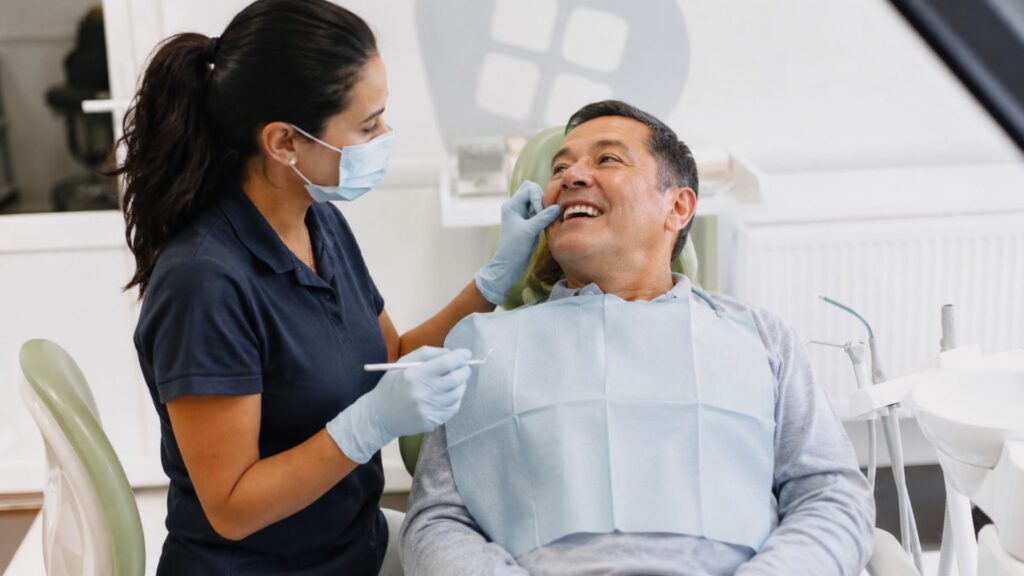
(Dentist showing a dental bridge model to a patient. Buen Pastor Medical Center in Hollywood, FL — affordable dental bridge.)
Dental Bridge Without Insurance | Hollywood, FL
Quick Answer: At Buen Pastor Medical Center — Dental Care in Hollywood, FL, dental bridges are available with no insurance required. Treatment starts with a $70 urgent evaluation — includes consultation, exam, and a focused X-ray — so you receive your written flat-fee bridge quote on the spot. You approve everything before we begin. A dental bridge is one of the most affordable, reliable ways to replace a missing tooth and restore your ability to chew and smile with confidence.
Call Our Bilingual Dental Team:
👉 📞 (954) 882-0191
👉 📅 Book Your Bridge Evaluation Today
👉 Explore All Dental Services in Hollywood, FL
📍 Location:
4440 Sheridan St., Suite C, Hollywood, FL 33021
Table of Contents
- What is a dental bridge and how does it work?
- Signs you need a bridge — and what happens if you leave a gap
- Dental bridge vs. implant — which is right for you?
- What happens during a dental bridge procedure
- Bridge materials and how long they last
- Our transparent pricing and evaluation options
- How to care for your dental bridge
- FAQs about dental bridges without insurance
What Is a Dental Bridge and How Does It Work?
A dental bridge is a fixed, non-removable restoration that literally bridges the gap left by one or more missing teeth. It consists of two main components: the pontic — the artificial tooth (or teeth) that fills the space — and the abutment crowns — custom-made caps that fit over the natural teeth on either side of the gap to anchor the bridge in place.
Once cemented, a dental bridge becomes a permanent part of your mouth. It does not come in and out like a partial denture. It looks, feels, and functions like natural teeth — and most patients find they quickly forget it is there.
Who is a good candidate for a dental bridge?
- Patients missing one or two consecutive teeth
- Patients with healthy natural teeth on both sides of the gap strong enough to support the bridge
- Patients who want a fixed solution without surgery
- Patients who had a tooth extracted and want to close the gap before shifting begins
A bridge is not suitable for every missing tooth situation. If the teeth on either side of the gap are not strong enough to support crowns, or if multiple non-consecutive teeth are missing, your dentist will discuss alternative options during your evaluation.
Signs You Need a Bridge — and What Happens If You Leave a Gap
Many patients delay replacing a missing tooth because the gap does not hurt — especially if the tooth was in the back of the mouth and is not visually obvious. This is one of the most common and costly mistakes in dentistry.
Signs a bridge is needed:
- A visible gap where a tooth was extracted or lost — particularly if adjacent teeth have already started to tilt slightly toward the space
- Difficulty chewing on one side — patients with a missing molar often shift all chewing to the other side, leading to uneven wear and jaw muscle imbalance
- A shifting bite — when a tooth is lost, opposing and neighboring teeth begin to move over time, changing the way your teeth meet and bite
- Speech changes — missing front teeth in particular can affect pronunciation of certain sounds
What happens when you leave a gap:
A missing tooth is not just a cosmetic issue. The consequences compound over time:
- Shifting teeth. The neighboring teeth begin to drift into the empty space. The opposing tooth erupts downward into the gap. Within months to years, a single missing tooth can cause misalignment across multiple teeth — creating the need for orthodontic treatment that did not previously exist.
- Bone loss. The jawbone beneath a missing tooth begins to shrink — losing both height and width — because there is no tooth root stimulating it. This bone loss accelerates over time and can eventually affect the neighboring teeth, the appearance of your jaw, and your candidacy for future implants.
- More expensive treatment later. A bridge placed now costs a fraction of the orthodontic realignment, bone grafting, and implant surgery that may be required if the gap is left untreated for years.
Dental Bridge vs. Implant — Which Is Right for You?
This is the most common question patients ask when facing a missing tooth — and the honest answer is that both are good options, serving different needs and budgets.
Dental bridge:
- No surgery required — the entire procedure is performed above the gumline
- Faster timeline — most bridges are completed in two appointments over 2–3 weeks
- Lower upfront cost
- Requires crowning the two adjacent teeth — healthy tooth structure on those teeth is reduced to accommodate the crowns
- Typically lasts 10 to 15 years with proper care before replacement may be needed
- Does not stop bone loss beneath the missing tooth
Dental implant:
- Requires oral surgery and a healing period of 3–6 months
- Higher upfront cost
- Does not involve the adjacent teeth — stands completely independently
- Stimulates the jawbone like a natural root, preventing bone loss
- Can last 20 years or longer with proper care
Which is right for you? If you want the most tooth-conserving, bone-preserving solution and can accommodate the cost and timeline, an implant is the stronger long-term choice. If you want a faster, more affordable fixed solution with no surgery, a bridge is an excellent choice — particularly when the adjacent teeth already need crowns.
The right answer depends on your specific oral health, the condition of your neighboring teeth, and your budget. Your dentist will evaluate all of this at your appointment and give you a clear written recommendation before any decision is made.
What Happens During a Dental Bridge Procedure
Getting a dental bridge at Buen Pastor Medical Center typically requires two appointments. Most patients find both far more comfortable than they expected.
Appointment 1 — Preparation:
- Step 1 — Evaluation and planning: Your dentist reviews your X-ray and examines the gap and surrounding teeth. You receive the written flat-fee bridge quote before anything begins. You approve it.
- Step 2 — Preparing the abutment teeth: The two teeth on either side of the gap are shaped and reduced — just as they would be for individual crowns — to create the precise surface needed for the bridge to seat securely. If either tooth has decay, it is addressed at this stage.
- Step 3 — Impression: A precise impression of the prepared teeth, the gap, and the opposing bite is taken. This is sent to the dental lab where your custom bridge is fabricated to fit your exact anatomy.
- Step 4 — Temporary bridge: A temporary bridge is placed to protect the prepared teeth and maintain the gap space while your permanent bridge is being made. You leave the first appointment with a functional, protected smile.
Appointment 2 — Placement:
- Step 5 — Permanent bridge cementation: Your custom bridge arrives from the lab. Your dentist checks the fit, shape, color, and bite — making final adjustments — and cements it permanently in place. You leave with a fully restored, fixed smile.
For many bridge cases, we complete most of the process right here in our Hollywood clinic — fewer trips, faster results.
Bridge Materials and How Long They Last
The material your bridge is made from affects its appearance, durability, and longevity. We use materials chosen for the right combination of strength and aesthetics for each patient’s specific situation.
Porcelain-fused-to-metal (PFM):
- A metal framework provides structural strength while a porcelain exterior creates a natural tooth-like appearance. PFM bridges are durable, well-tolerated, and well-suited for back teeth where chewing forces are highest.
All-ceramic (all-porcelain):
- No metal framework — the bridge is made entirely of high-strength ceramic. All-ceramic bridges offer superior aesthetics and are the preferred choice for front teeth where appearance is the priority.
How long does a dental bridge last?
- With proper care — daily brushing, regular use of floss threaders under the bridge, and routine dental visits — a well-made dental bridge can last 10 to 15 years. Some last longer. The longevity depends on the material, the location of the bridge, your oral hygiene habits, and whether you grind your teeth.
Will a bridge look like a real tooth?
- Yes — modern ceramic and porcelain materials allow light to pass through the restoration in a way that closely mimics natural enamel. Bridges can be placed on front or back teeth, and for visible areas we select materials that match your surrounding teeth so the restoration blends seamlessly with your natural smile.
Our Transparent Pricing and Evaluation Options
We designed our pricing for patients without dental insurance — clear, written, and confirmed before we begin.
🚨 Urgent Evaluation — $70
- For patients with a missing tooth, a gap they want addressed, or any urgent dental concern. Includes consultation, exam, and one focused X-ray. You receive your diagnosis and the written flat-fee bridge quote on the spot.
📋 New Patient Full Exam — $150
- For patients who have not been seen recently and want a complete evaluation of all teeth before deciding on treatment. Includes consultation, full exam, and 18 digital X-rays. Your dentist provides a complete written treatment plan with flat-fee pricing.
All bridge procedures are priced separately and provided to you in writing before treatment begins. The final price depends on the number of teeth being replaced, the material, and the complexity of the case. You approve everything first — always.
CareCredit, Sunbit, and Cherry are available for patients who want to spread the cost across flexible monthly payments.
Call Now:
👉 📞 (954) 882-0191
👉 📅 Book Your Bridge Evaluation
👉 Explore All Dental Services in Hollywood, FL
How to Care for Your Dental Bridge
A dental bridge requires slightly different home care than natural teeth — specifically around and beneath the pontic (the artificial tooth in the middle). This is where food and bacteria tend to accumulate and where problems most commonly develop.
Floss under the bridge every day — using a floss threader:
- Regular floss cannot reach beneath the pontic. A floss threader guides floss under the bridge to clean this critical area. Your hygienist will show you the technique at your appointment. A water flosser works well too.
Brush twice daily with fluoride toothpaste:
- Focus on the margins where the crowns meet the gumline on both abutment teeth — this is where decay most commonly develops.
Avoid biting hard or sticky foods:
- Ice, caramel, and chewing gum can dislodge or damage a bridge, particularly in the first weeks after placement.
Wear a night guard if you grind your teeth:
- Bruxism is one of the most common causes of premature bridge wear. A custom night guard protects your investment while you sleep.
Keep regular dental appointments:
- Your dentist checks the bridge at every exam for wear, loosening, or early decay at the margins. Catching a problem early is always less expensive.
If your bridge feels loose or comes off — call us immediately:
- Do not try to recement it yourself. A loose bridge can sometimes be cleaned and recemented — but only if addressed promptly before decay develops underneath.
Call Now:
👉 📞 (954) 882-0191
👉 📅 Book Your Bridge Evaluation
👉 Explore All Dental Services in Hollywood, FL
📧 Email: hello@buenpastordental.com
🕒 Hours: Monday–Friday 7:30am–5pm • Saturday 7:30am–3pm
📍 Address:
4440 Sheridan St., Suite C, Hollywood, FL 33021
Conveniently Located Near You: Proudly serving dental patients throughout South Florida, including:
- Hollywood, Hallandale Beach & Dania Beach
- Aventura, North Miami Beach & Sunny Isles Beach
- Fort Lauderdale, Oakland Park & Wilton Manors
- Pembroke Pines, Miramar & Weston
- Davie, Plantation & Cooper City
- North Miami, Miami Gardens & Bal Harbour
- Surfside & Southwest Ranches
🏆 Top-Rated Restorative Dentist in Hollywood, FL — Trusted across South Florida for affordable dental bridges, transparent pricing, and compassionate bilingual care.
FAQs About Dental Bridges Without Insurance
How much does a dental bridge cost without insurance?
- At Buen Pastor Medical Center — Dental Care, all bridge procedures are priced individually and provided to you in writing before treatment begins. Start with a $70 evaluation — your dentist provides the exact written quote before any treatment begins.
Is a dental bridge better than an implant?
- Neither is universally better — it depends on your situation. A bridge is faster, less expensive upfront, and requires no surgery. An implant is more tooth-conserving, prevents bone loss, and tends to last longer. Your dentist will evaluate your specific case and explain the pros and cons of each option clearly before you decide.
Does getting a bridge hurt?
- The procedure is performed under local anesthesia, so you should feel pressure but not pain. Some sensitivity around the prepared teeth is normal while wearing the temporary bridge — this resolves once the permanent bridge is placed. Most patients find the experience significantly more comfortable than they anticipated.
How long does a dental bridge last?
- With proper care — including daily flossing under the bridge with a floss threader — a dental bridge typically lasts 10 to 15 years. The longevity depends on the material, your oral hygiene habits, the location of the bridge, and whether you grind your teeth.
What happens if I don’t replace a missing tooth?
- Neighboring teeth begin to drift into the gap, the opposing tooth grows toward the empty space, and bone loss occurs beneath the missing tooth — often accelerating over months and years. What starts as a single missing tooth can become a much more complex and expensive problem to correct. Acting early is always the better clinical and financial decision.
⚠️ IMPORTANT:
- Buen Pastor Medical Center in Hollywood, FL is a private, self-pay practice.
- We are not affiliated with any insurance plans, Medicare, or Medicaid.
- Buen Pastor Medical Center — Centro Médico Buen Pastor
🚨 Dental Emergency Alert:
- If you are experiencing severe facial swelling that affects your breathing or swallowing, call 911 immediately — this is a life-threatening emergency.