
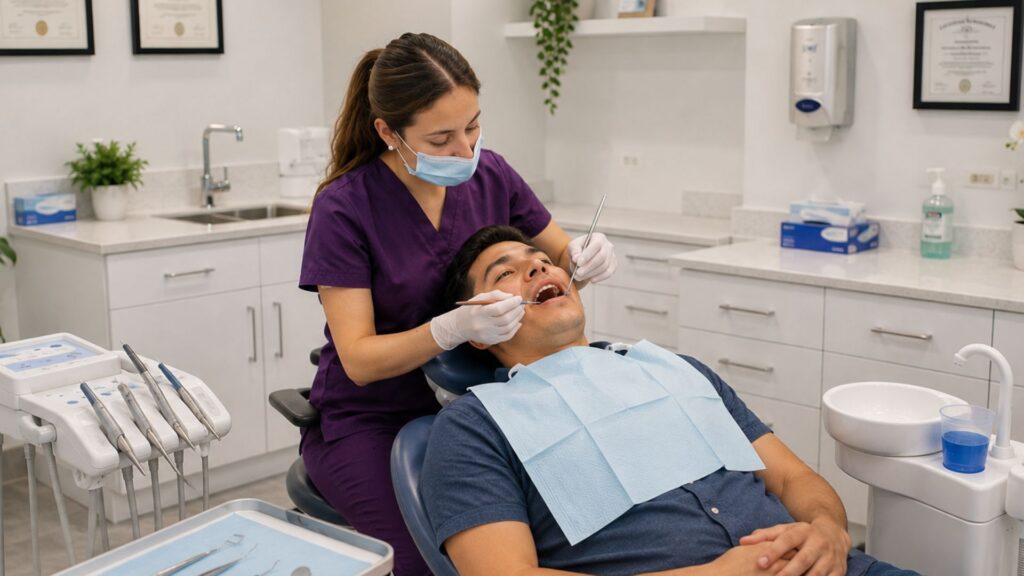
(Emergency dentist examining a patient with a tooth abscess and jaw swelling. Buen Pastor Medical Center Dental Care in Hollywood, FL — same-day treatment available.)
Tooth Abscess Treatment Without Insurance | Hollywood, FL
Quick Answer: At Buen Pastor Medical Center — Dental Care in Hollywood, FL, we treat tooth infections and dental abscesses the same day — $70 for your evaluation, with all treatment costs quoted in writing before anything begins.
A tooth abscess is not something that resolves on its own. The infection will not go away without treatment — and left untreated, it can spread beyond your jaw and become a serious health risk. If you have a swollen jaw, a pimple on your gum, a bad taste in your mouth, or a throbbing tooth with fever, you need to be seen today.
Call Our Bilingual Dental Team:
👉 📞 (954) 882-0191
👉 📅 Book Your Emergency Dental Visit Now
👉 Explore All Dental Services in Hollywood, FL
📍 Location:
4440 Sheridan St., Suite C, Hollywood, FL 33021
Table of Contents
- What is a tooth abscess and how does it form?
- Warning signs your tooth infection is serious
- Tooth abscess stages — and why timing matters
- Our $70 emergency exam and transparent treatment pricing
- How we treat tooth infections and abscesses
- Can antibiotics alone cure a tooth abscess?
- What to do right now if you think you have an abscess
- FAQs about tooth abscess treatment and dental infections
What Is a Tooth Abscess and How Does It Form?
A tooth abscess is a pocket of bacterial infection that forms either at the root of a tooth or in the gum tissue surrounding it. Unlike a regular toothache, a dental abscess is an active bacterial infection — and bacterial infections do not stay contained. They spread, and they worsen.
There are two main types, and understanding the difference helps explain why treatment varies:
Periapical Abscess:
- The most common type. Bacteria enter through a cavity, a crack, or a failed filling and reach the soft pulp inside the tooth — the tissue containing the nerve and blood supply. The infection travels down through the root and accumulates at the tip, forming a pus pocket at the base of the tooth. This type almost always requires either a root canal to save the tooth or an extraction if the damage is too extensive.
Periodontal (Gum) Abscess:
- This type forms in the gum tissue alongside the tooth rather than inside it — often triggered by advanced gum disease, food trapped beneath the gumline, or a deep pocket in the gum. Treatment focuses on draining the abscess and controlling the infection. Addressing the underlying gum condition, such as a deep cleaning, is typically handled as a follow-up appointment once the acute infection is under control.
Both types require the same urgency: same-day care. Waiting makes both the infection and your treatment options worse.
Warning Signs Your Tooth Infection Is Serious
Most patients come to us describing a combination of symptoms that built up over several days. Here is what a dental abscess typically looks and feels like:
- Throbbing pain that radiates from the tooth to your jaw, ear, or neck
- Visible swelling in your gum, cheek, or jaw — sometimes dramatic and asymmetrical
- A pimple-like bump on the gum near the painful tooth — this is the abscess draining
- A persistent bad taste or foul smell in your mouth, even after brushing
- Fever — the infection has triggered a systemic response in your body
- Sensitivity to pressure when biting, even gently
- Swollen lymph nodes under the jaw or in the neck
When to call 911 instead of a dentist:
- If the swelling has spread to your eye, your throat, or is making it difficult to breathe or swallow — call 911 immediately. This means the infection has spread beyond your jaw into critical airways and is a life-threatening emergency.
Tooth Abscess Stages — and Why Timing Matters
Tooth abscesses do not appear overnight. They develop in progressive stages, and each stage closes options that were still available at the stage before it.
Stage 1 — Enamel and Dentin Infection: Bacteria have entered the tooth through a cavity or crack. You may feel mild sensitivity or intermittent pain. At this stage, a filling or a small restoration can often stop the progression entirely.
Stage 2 — Pulp Involvement: The infection has reached the nerve. Pain becomes constant, throbbing, and often worse at night or when lying down. A root canal at this stage saves the tooth and eliminates the infection.
Stage 3 — Periapical Abscess Formation: The infection has traveled through the root and formed a pus pocket at the base of the tooth. You may notice gum swelling, a visible bump, or a bad taste. Root canal or extraction is now required, and antibiotics are needed to control spreading infection.
Stage 4 — Spreading Infection: The abscess has begun spreading beyond the tooth into surrounding bone, tissue, or the jaw. Facial swelling, fever, and difficulty opening the mouth are common. This is a dental emergency requiring immediate treatment — and in severe cases, hospitalization.
The earlier you are seen, the simpler and less expensive your treatment will be. A Stage 1 infection treated with a filling costs a fraction of what a Stage 3 or 4 requires. Do not wait to see which stage you are at.
Our $70 Emergency Exam and Transparent Treatment Pricing
We built our pricing specifically for patients without dental insurance — clear, upfront, and simple.
- Urgent Dental Evaluation: $70 (consultation + clinical exam + one X-ray focused on the specific problem tooth — not a full-mouth exam)
- Incision and Drainage (I&D): Flat fee — quoted in writing before the procedure. Typically provides rapid relief of abscess pressure
- Antibiotics: Priced separately — always disclosed before dispensing
- Root Canal Treatment: Flat fee — quoted in writing; financing available through CareCredit, Sunbit, and Cherry
- Tooth Extraction: Flat fee — simple and surgical extractions quoted upfront
You approve everything first — always. We will never begin a procedure without your written consent and a clear cost in hand.
Call Now:
👉 📞 (954) 882-0191
👉 📅 Book Your Emergency Dental Exam
👉 Explore All Dental Services in Hollywood, FL
How We Treat Tooth Infections and Abscesses
Once your $70 evaluation is complete and your X-ray is reviewed, your dentist explains exactly what is happening inside your tooth and gives you a flat-fee quote for the appropriate treatment. In most cases, we perform the necessary procedure during the same visit. Here is how each scenario typically plays out:
🩺 Incision and Drainage (I&D):
- If there is a visible, swollen abscess — soft and tender to the touch, filled with pus — your dentist will make a small incision to drain it and relieve the pressure. This is one of the fastest ways to reduce the intense throbbing pain of an abscess. Drainage alone does not cure the infection — antibiotics and definitive treatment of the tooth are still needed — but the relief is almost immediate.
💊 Antibiotic Therapy:
- For abscesses that have not yet formed a drainable collection, or following drainage, antibiotics are prescribed to control the bacterial infection and prevent it from spreading. Your dentist will determine the right antibiotic based on your specific infection, medical history, and any allergies. Antibiotics alone do not cure the cause — the source of infection inside the tooth must still be addressed.
🔬 Root Canal Treatment:
- When the infection originated inside the tooth pulp — the most common scenario — a root canal removes the infected tissue, cleans and seals the canals, and preserves your natural tooth. Most patients are surprised by how comfortable the procedure is compared to the pain they arrived with.
🔌 Tooth Extraction:
- When a tooth is too damaged or the infection is too advanced to treat with a root canal, extraction removes the tooth and eliminates the source of infection entirely. We perform both simple and surgical extractions under local anesthesia. Once you have healed, our dental team can discuss replacement options that fit your situation and budget.
Can Antibiotics Alone Cure a Tooth Abscess?
This is one of the most important questions we answer — because many patients have already tried antibiotics from an urgent care clinic or ER before coming to see us.
The honest answer: no, antibiotics cannot cure a dental abscess. They can reduce the bacterial load, bring down a fever, and prevent the infection from spreading to other areas of the body — but they cannot eliminate the source of the infection, which is inside your tooth. Once you stop taking the antibiotics, the infection returns.
Think of it this way: if you had a splinter infected under your skin, antibiotics would help control the surrounding infection — but the splinter still has to come out. A dental abscess works the same way. The infected tissue inside the tooth is the splinter. Only a root canal or extraction removes it.
This is why patients who go to the ER for a swollen jaw come back to us weeks later — the antibiotics bought them time, but the underlying problem was never fixed.
If you have already taken a round of antibiotics and your symptoms came back, call us. That is exactly the situation we handle every day.
What to Do Right Now If You Think You Have an Abscess
If you are reading this in pain, here is what you can do before your visit:
Rinse gently with warm salt water:
- Mix half a teaspoon of salt in a glass of warm water and rinse around the affected area for 30 seconds. This helps reduce bacterial load in the mouth and can soothe irritated gum tissue.
Take ibuprofen if you can tolerate it:
- Ibuprofen (Advil, Motrin) reduces both pain and inflammation better than acetaminophen (Tylenol) for dental infections. Take it with food and follow package directions.
Do not apply heat to the outside of your face:
- Heat draws blood to the area and can accelerate the spread of infection. A cold compress on the cheek — 15 minutes on, 15 minutes off — is safer for swelling.
Do not squeeze or try to drain the abscess yourself:
- This can push bacteria deeper into surrounding tissue and make the infection worse.
Call us and come in: These steps manage symptoms temporarily — they do not treat the infection. The longer an abscess goes without drainage and treatment, the more it spreads and the more complex your treatment becomes.
Call Now:
👉 📞 (954) 882-0191
👉 📅 Book Your Same-Day Dental Visit
👉 Explore All Dental Services in Hollywood, FL
📧 Email: hello@buenpastordental.com
🕒 Hours: Monday–Friday 7:30am–5pm • Saturday 7:30am–3pm
📍 Address:
4440 Sheridan St., Suite C, Hollywood, FL 33021
Conveniently Located Near You: Proudly serving dental patients throughout South Florida, including:
- Hollywood, Hallandale Beach & Dania Beach
- Aventura, North Miami Beach & Sunny Isles Beach
- Fort Lauderdale, Oakland Park & Wilton Manors
- Pembroke Pines, Miramar & Weston
- Davie, Plantation & Cooper City
- North Miami, Miami Gardens & Bal Harbour
- Surfside & Southwest Ranches
🏆 Top-Rated Emergency Dentist in Hollywood, FL — Trusted across South Florida for fast, affordable tooth abscess treatment, transparent pricing, and compassionate bilingual dental care under one roof.
FAQs About Tooth Abscess Treatment and Dental Infections
How much does tooth abscess treatment cost without insurance?
- Your visit starts with a flat $70 Urgent Dental Evaluation, which includes the consultation, exam, and one X-ray focused on the specific problem tooth. After the evaluation, your dentist gives you the exact flat-fee cost for all needed treatment — drainage, antibiotics, root canal, or extraction — in writing before you decide. You always know what you owe before anything begins.
Can a tooth abscess go away on its own?
- No. A tooth abscess cannot heal without treatment. The infection may temporarily appear to calm down — especially if the abscess ruptures and drains on its own — but the source of the infection inside the tooth remains. The infection will return, often worse than before. If your gum pimple has burst and the pain has reduced, that is not a sign you are getting better — it is a sign the abscess has drained temporarily. You still need to be seen.
What happens if you leave a tooth abscess untreated?
- Untreated dental abscesses can spread to the jawbone, the soft tissues of the neck, and — in rare but serious cases — the airway and brain. Ludwig’s angina is a potentially life-threatening spread of oral infection that requires hospitalization. While severe spread is uncommon, it is entirely preventable with prompt dental treatment. Do not wait to see if the pain goes away.
Will the dentist pull the tooth if it is abscessed?
- Not necessarily. Our dentists always try to save your natural tooth when possible. If a root canal can remove the infection and restore the tooth, that is our first choice. Extraction becomes necessary when the tooth is too damaged to save or the infection is too advanced. Your dentist will be honest with you about which option applies to your specific situation.
Can tooth infection spread to brain or heart?
- In rare cases, severe untreated tooth infections have spread to the brain (causing a brain abscess) or contributed to endocarditis — a serious heart infection. These are not common outcomes, but they are real risks of leaving a dental abscess completely untreated for extended periods. This is not meant to frighten you — it is meant to clarify why same-day dental care for an abscess is genuinely important.
Is a tooth abscess contagious?
- The bacteria that cause dental abscesses — primarily oral streptococci and anaerobes — can transfer through saliva. They are not contagious in the way a cold virus spreads, but sharing utensils, cups, or kissing someone with an active oral infection carries some transmission risk, particularly to people with compromised immune systems.
⚠️ IMPORTANT:
- Buen Pastor Medical Center in Hollywood, FL is a private, self-pay practice.
- We are not affiliated with any insurance plans, Medicare, or Medicaid.
- Buen Pastor Medical Center — Centro Médico Buen Pastor
🚨 Dental Emergency Alert:
- If you are experiencing severe facial swelling that affects your breathing or swallowing, call 911 immediately — this is a life-threatening emergency.