
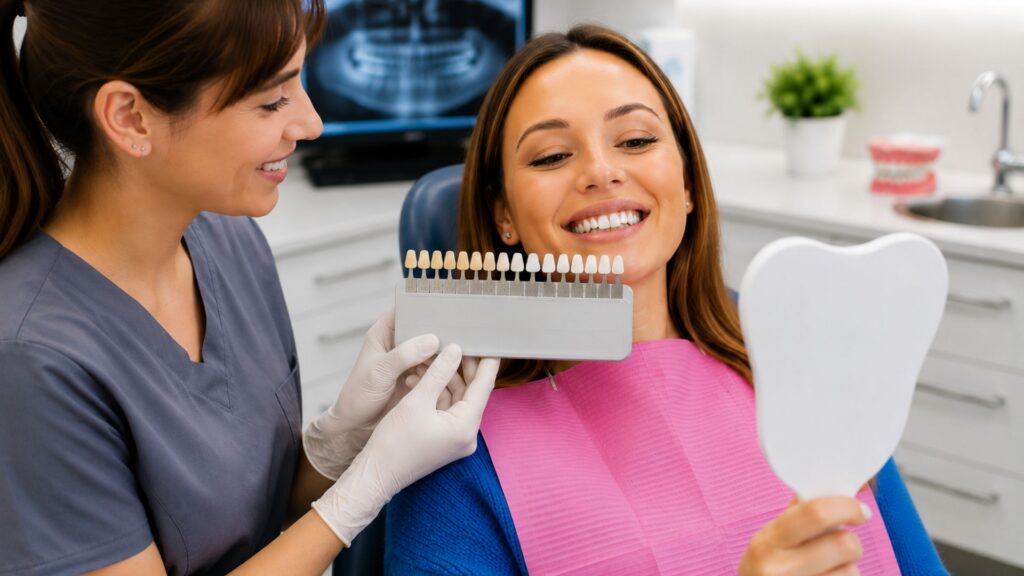
(Dentist showing teeth shade guide to a patient. Buen Pastor Medical Center Dental Care in Hollywood, FL — professional teeth whitening and cosmetic bonding.)
Teeth Whitening Without Insurance | Hollywood, FL Dentist
Quick Answer: At Buen Pastor Medical Center — Dental Care in Hollywood, FL, we offer professional-grade teeth whitening and cosmetic dental bonding — safer and more effective than anything available in a store. No insurance required. Ask about current whitening pricing at your visit or when you call.
If yellowing, staining, or a chipped front tooth has been affecting how comfortable you feel about your smile, you are in the right place. Cosmetic dental care does not have to be expensive or complicated. We keep it honest, affordable, and effective.
Call Our Bilingual Dental Team:
👉 📞 (954) 882-0191
👉 📅 Book Your Cosmetic Dental Consultation Today
👉 Explore All Dental Services in Hollywood, FL
📍 Location:
4440 Sheridan St., Suite C, Hollywood, FL 33021
Table of Contents
- Why professional teeth whitening is different from store kits
- What causes yellow and stained teeth?
- Cosmetic dental bonding — the fast fix for chips, gaps, and shape
- Is teeth whitening safe? What patients ask most
- Professional whitening vs. veneers — which is right for you?
- What to expect at your whitening or cosmetic consultation
- How to maintain your results after whitening
- FAQs about teeth whitening and cosmetic dentistry
Why Professional Teeth Whitening Is Different From Store Kits
Walk into any pharmacy and you will find rows of whitening strips, trays, toothpastes, and pens. Most patients have tried at least one of them. And most patients reach the same conclusion: the results are mild at best, inconsistent, and wear off quickly.
The reason comes down to concentration and delivery.
Store-bought whitening products use low-concentration peroxide:
- By law, over-the-counter whitening products contain a fraction of the peroxide concentration that a licensed dentist can apply. The active ingredient is there — just not enough of it to produce a meaningful, lasting result on most types of staining.
Generic trays do not fit your teeth:
- Store kits use one-size trays that allow the whitening gel to leak onto your gums, causing irritation and, in some cases, soreness on the soft tissue. This is why so many patients report sensitivity or gum discomfort after at-home kits — not because whitening itself is painful, but because the delivery is imprecise.
Professional whitening is applied and monitored by your dentist:
- The concentration is stronger, the delivery is precise, and the treatment is adjusted based on your specific level of staining and tooth sensitivity. The result is a noticeably different shade achieved safely and comfortably.
The difference patients notice:
- Professional whitening produces results that at-home kits simply cannot match — and without the gum irritation that comes from improperly fitting trays and uncontrolled gel contact.
What Causes Yellow and Stained Teeth?
Understanding why your teeth have changed color helps set realistic expectations for whitening — and helps you protect your results after treatment.
Surface stains (extrinsic staining):
- These are deposits on the outer enamel surface caused by what you eat, drink, and smoke. Coffee, tea, red wine, and tobacco are the four most common causes of surface staining — and they are also the type of staining that responds best to professional whitening.
Deep staining (intrinsic discoloration):
Intrinsic staining occurs inside the tooth structure itself — not on the surface. Causes include:
- Certain antibiotics taken during childhood (tetracycline)
- Excessive fluoride exposure during tooth development
- Aging — the outer enamel layer naturally thins over time, allowing the naturally yellower dentin beneath to show through
- Trauma — a tooth that has been hit or injured may darken internally
Intrinsic staining responds differently to whitening than surface staining. Your dentist evaluates the type and source of your discoloration at the consultation and gives you an honest picture of the results you can realistically expect.
What whitening cannot fix:
- Whitening works on natural tooth enamel — it does not change the color of dental work including crowns, veneers, bonding, or fillings. If you have existing restorations in visible front teeth, your dentist will discuss this with you before treatment begins so there are no surprises.
Cosmetic Dental Bonding — The Fast Fix for Chips, Gaps, and Shape
Teeth whitening addresses color. Dental bonding addresses shape — and for many patients, it is the faster, more affordable path to a noticeably improved smile.
What is dental bonding?
- Dental bonding uses a tooth-colored composite resin — the same material used for tooth-colored fillings — applied directly to the tooth surface, shaped to the desired form, and hardened with a curing light. The entire process is completed in a single visit and requires no anesthetic in most cases.
What can bonding correct?
- A chipped or cracked tooth — the most common cosmetic concern we see
- A small gap between front teeth
- A tooth that is noticeably shorter than the surrounding teeth
- Slight discoloration or staining on a single tooth that does not respond to whitening
- A tooth with an irregular or uneven edge
Bonding vs. veneers:
- Veneers are thin porcelain shells that cover the entire front surface of a tooth. They are custom-fabricated in a laboratory and require two appointments. Veneers are more durable and stain-resistant long-term — but they also cost significantly more than bonding and require removing a thin layer of enamel that cannot be replaced.
- Dental bonding is an excellent solution for patients who want a meaningful cosmetic improvement without the cost and commitment of veneers. How long results last depends on the location of the bonding, your diet, and how well you maintain it — your dentist will give you a realistic expectation at the consultation.
Both options — bonding and veneers — are discussed at your consultation:
- Your dentist explains which is appropriate for your specific concern, gives you the cost in writing, and you decide before any treatment begins.
Is Teeth Whitening Safe? What Patients Ask Most
Professional teeth whitening has been studied and used safely in dental offices for decades. For most patients with healthy teeth and gums, it is a low-risk procedure when performed correctly.
Common concerns — and the honest answers:
Will whitening damage my enamel?
- No — when performed at appropriate concentrations by a dental professional, whitening does not damage enamel. The peroxide temporarily opens the pores of the enamel surface to remove staining molecules, then the enamel rehydrates and returns to its normal state. Over-the-counter abuse (using strips far more often than directed) is more likely to cause sensitivity than a professionally supervised treatment.
Will it make my teeth sensitive?
- Some patients experience temporary sensitivity during or after whitening — particularly to cold temperatures. This typically resolves within 24 to 48 hours. Patients who already have sensitive teeth may experience more. Your dentist reviews your dental health before recommending whitening and can adjust the protocol if needed.
Who should not whiten?
- Whitening is not recommended for patients who are pregnant or nursing, patients under age 16 (whose pulps are still developing), or patients with significant untreated decay or active gum disease. This is why whitening should always start with a dental evaluation — it ensures you are a good candidate before the treatment begins.
Is whitening permanent?
- No whitening treatment is truly permanent. Results typically last one to three years depending on your diet, oral hygiene, and lifestyle habits. Coffee, tea, red wine, and tobacco accelerate restaining. With good habits and periodic maintenance, most patients maintain noticeably brighter teeth long-term.
Professional Whitening vs. Veneers — Which Is Right for You?
Two of the most-searched cosmetic dental topics are whitening and veneers — and many patients are not sure which one actually fits their situation. Here is a simple breakdown:
Choose whitening if:
- Your main concern is the overall color of your teeth — yellowing or surface staining
- Your teeth are otherwise in good shape — no significant chips, cracks, or irregular shapes
- You want the most affordable cosmetic improvement available
- You are looking for a result you can achieve in one appointment
Choose bonding if:
- A specific tooth is chipped, cracked, or has an irregular edge
- You have a small gap you would like to close
- A single tooth is noticeably darker than the rest and does not match
- You want a fast, affordable cosmetic fix without laboratory work
Consider veneers if:
- You want a comprehensive, long-lasting transformation of multiple front teeth
- You have significant shape, size, and color concerns that bonding alone cannot fully address
- You are prepared for a higher investment and a two-visit process
For most patients who come to us asking about cosmetic dentistry, whitening or bonding — or both — achieves everything they are hoping for. Veneers are genuinely indicated in fewer cases than cosmetic marketing suggests.
What to Expect at Your Whitening or Cosmetic Consultation
The process is simple, transparent, and completely under your control.
Step 1 — Evaluation: Your dentist examines your teeth, evaluates the type and depth of staining, and checks that you are a good candidate for whitening. If you have existing dental work in your front teeth, this is discussed upfront.
Step 2 — Your options, explained simply: Your dentist explains what whitening can and cannot achieve in your specific case, whether bonding makes sense for any cosmetic concerns, and what results are realistic. Everything is communicated in plain language.
Step 3 — Pricing in writing: You receive the cost of each recommended treatment in writing before any procedure begins. You decide what to do and when to do it — there is no pressure.
Step 4 — The procedure: Whitening typically takes about 45 to 60 minutes in-chair. Bonding takes 30 to 60 minutes per tooth. Most patients leave the same appointment noticeably happier with their smile.
How to Maintain Your Results After Whitening
A professional whitening treatment is an investment — and a few consistent habits protect it for as long as possible.
Limit staining foods and beverages:
- Coffee, tea, red wine, and dark sodas are the primary culprits. If you cannot cut them out completely, drinking through a straw reduces direct contact with tooth surfaces — particularly helpful for iced coffee and tea.
Rinse after staining foods:
- A quick rinse with water after coffee or tea removes surface pigments before they can settle into the enamel. You do not need to brush immediately — in fact, brushing too soon after eating can wear enamel that has softened from food acids.
Use a whitening toothpaste for maintenance:
- A mild whitening toothpaste used once daily helps maintain results between professional visits. Ask your dentist which formulation is appropriate for your teeth.
Avoid tobacco:
- Tobacco — whether smoked or chewed — is the single fastest way to restain whitened teeth. It also causes gum disease, oral cancer, and tooth loss. There is no dental workaround for tobacco use.
Schedule periodic touch-up appointments:
- Most patients return for a brief touch-up every one to two years depending on their lifestyle. This is significantly faster and less expensive than a full initial treatment.
Call Now:
👉 📞 (954) 882-0191
👉 📅 Book Your Cosmetic Dental Appointment
👉 Explore All Dental Services in Hollywood, FL
📧 Email: hello@buenpastordental.com
🕒 Hours: Monday–Friday 7:30am–5pm • Saturday 7:30am–3pm
📍 Address:
4440 Sheridan St., Suite C, Hollywood, FL 33021
Conveniently Located Near You: Proudly serving dental patients throughout South Florida, including:
- Hollywood, Hallandale Beach & Dania Beach
- Aventura, North Miami Beach & Sunny Isles Beach
- Fort Lauderdale, Oakland Park & Wilton Manors
- Pembroke Pines, Miramar & Weston
- Davie, Plantation & Cooper City
- North Miami, Miami Gardens & Bal Harbour
- Surfside & Southwest Ranches
🏆 Top-Rated Family Dentist in Hollywood, FL — Trusted across South Florida for affordable professional teeth whitening, cosmetic bonding, and compassionate bilingual dental care for the whole family.
FAQs About Teeth Whitening and Cosmetic Dentistry
How much does professional teeth whitening cost without insurance?
- The cost of professional whitening varies depending on the treatment type and the degree of staining. At Buen Pastor Medical Center — Dental Care, we provide the exact price in writing before any treatment begins. The best way to get an accurate number for your specific situation is to call us or come in for a consultation — we will tell you exactly what your whitening treatment costs before you commit to anything.
How many shades whiter will my teeth get?
- This depends on the type and degree of staining, your natural enamel color, and the whitening protocol used. Surface stains from coffee, tea, and tobacco typically respond well and produce the most dramatic results. Intrinsic discoloration — staining inside the tooth structure — responds more modestly. Your dentist gives you a realistic estimate after evaluating your teeth.
How long does professional teeth whitening last?
- Most patients see results that last one to three years. The variables are your diet, whether you smoke, and how consistently you maintain your oral hygiene. Patients who drink a lot of coffee or tea and do not take maintenance steps will restain faster than patients who limit those habits.
Can I whiten my teeth if I have crowns or veneers?
- Whitening does not change the color of existing dental work — crowns, veneers, bonding, and fillings are not affected by the whitening agent. If your front teeth include any of these restorations, your dentist will discuss what the result will look like before treatment so you can make an informed decision.
Is dental bonding the same as veneers?
- No — they are different materials and processes. Bonding uses a composite resin applied and shaped directly in the office in a single visit. Veneers are thin porcelain shells custom-made in a laboratory and bonded to the front of the tooth in a second appointment. Bonding is faster and less expensive; veneers are more durable and stain-resistant long-term. Your dentist helps you determine which makes sense for your specific situation.
⚠️ IMPORTANT:
- Buen Pastor Medical Center in Hollywood, FL is a private, self-pay practice.
- We are not affiliated with any insurance plans, Medicare, or Medicaid.
- Buen Pastor Medical Center — Centro Médico Buen Pastor
🚨 Dental Emergency Alert:
- If you are experiencing severe facial swelling that affects your breathing or swallowing, call 911 immediately — this is a life-threatening emergency.