
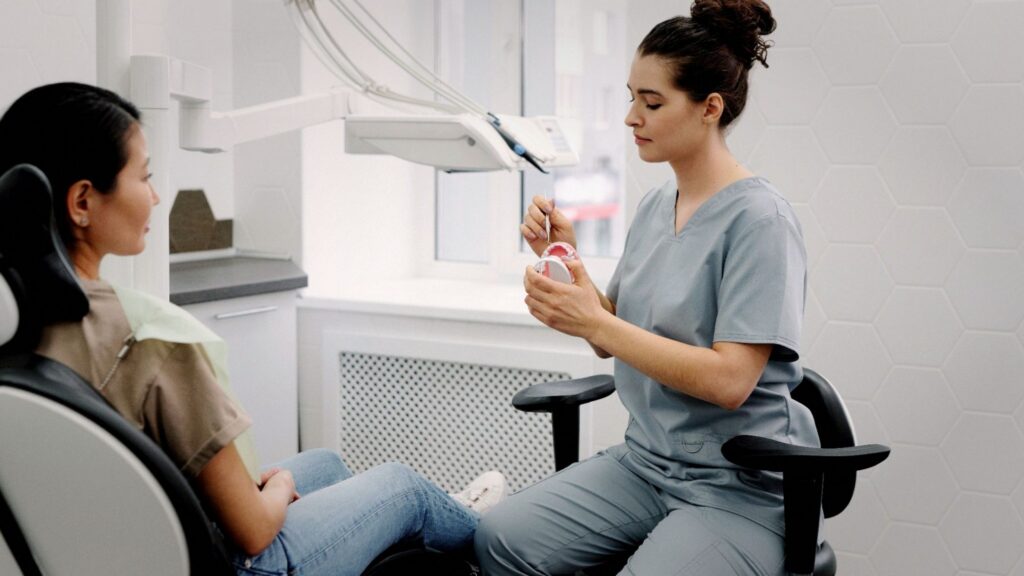
(Dental hygienist reviewing periodontal maintenance chart with patient. Buen Pastor Medical Center in Hollywood, FL — affordable gum disease follow-up care.)
Periodontal Maintenance Without Insurance | Hollywood, FL
Quick Answer: At Buen Pastor Medical Center — Dental Care in Hollywood, FL, periodontal maintenance appointments are scheduled every 3 to 4 months for patients who have completed deep cleaning. Pricing is quoted individually based on your specific gum health — call or visit to get your written quote. No insurance required. These specialized maintenance visits are what protect your deep cleaning investment and keep gum disease from returning.
Call Our Bilingual Dental Team:
👉 📞 (954) 882-0191
👉 📅 Schedule Your Periodontal Maintenance Today
👉 Explore All Dental Services in Hollywood, FL
📍 Location:
4440 Sheridan St., Suite C, Hollywood, FL 33021
Table of Contents
- What is periodontal maintenance and why do you need it?
- Why every 3 to 4 months — not 6?
- Periodontal maintenance vs. regular cleaning — the critical difference
- What happens during a periodontal maintenance visit
- What happens if you skip periodontal maintenance
- Pricing and what to expect at your maintenance appointment
- Home care between visits — what actually makes a difference
- FAQs about periodontal maintenance without insurance
What Is Periodontal Maintenance and Why Do You Need It?
If you have completed a deep cleaning — scaling and root planing — you have already done the hardest part. The active infection has been treated. The tartar below your gumline has been removed. Your gum tissue has begun to heal.
But gum disease does not work like a broken bone that heals and stays healed. Periodontitis is a chronic bacterial condition. The bacteria that caused your gum disease are still present in your mouth — and without consistent professional management, they will recolonize the cleaned root surfaces and pockets within months. This is not a failure of your home care or your deep cleaning. It is simply how the biology of periodontal disease works.
Periodontal maintenance — also called supportive periodontal therapy (SPT) — is the specialized cleaning program designed specifically for patients with a history of gum disease. It is different from a routine cleaning in both technique and purpose. It is the only way to maintain the results of your deep cleaning long-term.
Think of it this way: deep cleaning treats the disease. Periodontal maintenance keeps it from coming back.
Who needs periodontal maintenance?
- Any patient who has been diagnosed with periodontitis and completed deep cleaning (scaling and root planing) needs periodontal maintenance. This is not optional — it is the medically necessary continuation of your periodontal treatment. Patients who return to routine six-month cleanings after deep cleaning are at significantly higher risk of disease relapse than patients who maintain the recommended 3 to 4 month schedule.
When does it start?
- In most cases, your first periodontal maintenance visit is scheduled 4 to 6 weeks after your deep cleaning is complete — once your gum tissue has had time to heal and begin reattaching to the cleaned root surfaces. At that first visit, your dentist re-measures your pockets to assess healing and establishes your ongoing maintenance interval.
Why Every 3 to 4 Months — Not 6?
The 6-month cleaning schedule is designed for patients with healthy gums and no history of periodontal disease. For patients who have had periodontitis, 6 months is too long.
Here is the clinical reason: after a deep cleaning, the bacterial population in your gum pockets is significantly reduced. But bacteria are relentless. Research consistently shows that bacterial levels in treated periodontal pockets begin to approach pre-treatment levels within 8 to 12 weeks — approximately 2 to 3 months. By 6 months, the bacterial recolonization in susceptible patients is often sufficient to trigger active inflammation and tissue breakdown again.
A 3 to 4 month schedule interrupts this bacterial recolonization cycle before it can cause damage. Each maintenance visit resets the clock — reducing bacterial load, re-measuring pocket depths, identifying any areas of early relapse, and reinforcing home care techniques.
Your schedule is individualized. Not every patient with a history of periodontal disease needs the same interval. Patients with well-controlled disease and excellent home care may eventually extend to every 4 months. Patients with more aggressive disease, deeper residual pockets, or systemic conditions like diabetes may need visits every 3 months or even more frequently. Your dentist determines the right interval at each visit based on your measurements — not a fixed schedule.
Periodontal Maintenance vs. Regular Cleaning — The Critical Difference
This is one of the most important things to understand about your post-treatment care — and one of the most common points of confusion.
Regular cleaning (prophylaxis) — for healthy gums:
- Removes plaque and tartar from above the gumline
- Takes 45 to 60 minutes
- Appropriate for patients with no history of gum disease
- Scheduled every 6 months
- Does not include subgingival scaling in active pockets
Periodontal maintenance — for patients with a history of gum disease:
- Removes plaque and tartar from both above and below the gumline
- Includes assessment of all periodontal pockets — measuring depth, bleeding, and signs of active disease
- Takes 60 to 90 minutes
- Scheduled every 3 to 4 months
- Reviews and reinforces home care specific to your periodontal condition
Why this distinction matters:
- A regular cleaning does not address the subgingival areas where periodontal disease lives. If you have a history of periodontitis and you are receiving only routine prophylaxis every 6 months, the areas below your gumline are not being properly maintained — and your disease is likely progressing silently between visits.
- Periodontal maintenance is a different procedure from a routine cleaning — it requires more time, more specialized technique, and clinical monitoring that goes beyond what a standard prophylaxis provides.
Can you switch back to regular cleanings?
- Patients who switch between periodontal maintenance and routine prophylaxis — alternating the two — do not achieve the same long-term outcomes as patients who maintain a consistent periodontal maintenance schedule. Once you have a diagnosis of periodontitis, periodontal maintenance is your cleaning — not a temporary upgrade from routine care.
What Happens During a Periodontal Maintenance Visit
Patients who expect a periodontal maintenance visit to feel like a regular cleaning are sometimes surprised by how thorough it is.
Comprehensive periodontal examination:
- Your hygienist or dentist measures every gum pocket in your mouth — typically recording 6 measurements per tooth — and compares them to your previous readings. Bleeding on probing is noted. Any areas showing increased pocket depth or signs of active infection are flagged. This assessment tells your dentist exactly how your gums are responding to treatment and whether any areas need additional attention.
Subgingival scaling:
- Unlike a routine cleaning, periodontal maintenance includes scaling below the gumline in all pockets — not just the areas that show obvious buildup. The bacterial biofilm that forms in periodontal pockets must be disrupted at every visit. Ultrasonic scalers and hand instruments are used systematically across the entire mouth.
Selective root planing:
- In areas where the examination reveals active inflammation, deeper deposits, or increased pocket depth, root planing is performed to smooth the root surface and reduce the conditions that allow bacteria to reattach.
Polishing and irrigation:
- After scaling, the teeth are polished to remove surface stains and biofilm. Antimicrobial irrigation may be used in areas with persistent inflammation to reduce the bacterial load between visits.
Home care review:
- Your hygienist reviews your home care technique at each visit — not as a lecture, but as targeted coaching. If plaque is concentrating in specific areas, they show you exactly where and adjust your technique accordingly.
Scheduling your next visit:
- Before you leave, your next appointment is scheduled based on your current measurements and disease status.
What Happens If You Skip Periodontal Maintenance
This is the most important section of this blog — because the consequences of skipping maintenance are the reason the 3 to 4 month schedule exists.
Within the first 2 to 3 months after a missed visit:
- Bacterial levels in your periodontal pockets begin to approach pre-treatment levels. The gum tissue, which had been healing and reattaching to the cleaned root surfaces, begins to re-inflame. You may not notice any symptoms — gum disease is largely painless in its early progression.
Within 6 months of skipping:
- Active inflammation is typically detectable by probing. Pocket depths begin to increase. Bone loss — the irreversible consequence of untreated periodontitis — may begin to occur in susceptible areas.
Long-term consequence of inconsistent maintenance:
- Patients who complete deep cleaning but skip periodontal maintenance consistently show greater bone loss, tooth mobility, and tooth loss over time compared to patients who maintain the recommended schedule. The deep cleaning investment is effectively lost.
- The car maintenance analogy is apt: skip the oil change long enough and the engine fails. The cost of maintenance is far less than the cost of retreatment or tooth replacement.
What happens if relapse occurs:
- If your maintenance visits reveal that active gum disease has returned, your dentist may recommend retreatment — which typically means additional deep cleaning of the affected areas. Early detection at maintenance visits prevents these outcomes — which is the entire purpose of the program.
Pricing and What to Expect at Your Maintenance Appointment
Periodontal maintenance is priced individually — based on your specific gum health status, the extent of scaling needed, and how your disease has responded to treatment.
No insurance required. CareCredit, Sunbit, and Cherry are available for patients who want to spread the cost of ongoing maintenance across monthly payments.
What to bring to your first maintenance visit:
- Your most recent dental X-rays if you were treated elsewhere
- A list of any medications you are currently taking — some medications affect gum health and your maintenance schedule
- Any changes in your medical history since your deep cleaning — systemic conditions like diabetes, heart disease, or pregnancy affect your periodontal condition
Home Care Between Visits — What Actually Makes a Difference
Periodontal maintenance works best when it is supported by consistent, effective home care. This is not about brushing harder — it is about reaching the right areas with the right technique.
Brush along the gumline — not just the tooth surface:
- Position your soft-bristled brush at a 45-degree angle toward the gum. The goal is to disrupt the plaque that accumulates at and just below the gumline where your pockets are. Two minutes, twice daily, without exception.
Floss every single day:
- Patients with a history of periodontal disease who do not floss daily are not maintaining their gum health between visits — regardless of anything else they do. The spaces between teeth are where periodontal pockets are deepest and where bacteria accumulate fastest.
Consider an interdental brush or water flosser:
- For patients with deeper residual pockets or larger spaces between teeth, an interdental brush or water flosser reaches areas standard floss cannot. Ask your hygienist which tool fits your specific pocket configuration.
Use an antimicrobial mouthwash:
- An antimicrobial rinse such as chlorhexidine or an over-the-counter antiseptic mouthwash used once daily significantly reduces the bacterial count between professional visits. Ask your hygienist for a specific recommendation.
Monitor for warning signs:
- If your gums begin bleeding again, if you notice a tooth feels loose, or if any area becomes tender between visits — contact us immediately. Early intervention prevents relapse from becoming retreatment.
Call Now:
👉 📞 (954) 882-0191
👉 📅 Schedule Your Periodontal Maintenance Today
👉 Explore All Dental Services in Hollywood, FL
📧 Email: hello@buenpastordental.com
🕒 Hours: Monday–Friday 7:30am–5pm • Saturday 7:30am–3pm
📍 Address:
4440 Sheridan St., Suite C, Hollywood, FL 33021
Conveniently Located Near You: Proudly serving dental patients throughout South Florida, including:
- Hollywood, Hallandale Beach & Dania Beach
- Aventura, North Miami Beach & Sunny Isles Beach
- Fort Lauderdale, Oakland Park & Wilton Manors
- Pembroke Pines, Miramar & Weston
- Davie, Plantation & Cooper City
- North Miami, Miami Gardens & Bal Harbour
- Surfside & Southwest Ranches
🏆 Top-Rated Gum Disease Care in Hollywood, FL — Trusted across South Florida for affordable periodontal maintenance, transparent pricing, and compassionate bilingual dental care.
FAQs About Periodontal Maintenance Without Insurance
How much does periodontal maintenance cost without insurance?
- Periodontal maintenance at Buen Pastor Medical Center — Dental Care is priced individually based on your gum health status and the extent of care needed at each visit.
Do I need periodontal maintenance forever?
- For most patients with a history of periodontitis, yes — ongoing maintenance is a permanent part of your dental care. Periodontitis is a chronic condition that cannot be cured, only managed. Some patients with well-controlled disease and excellent home care may eventually extend their intervals, but most patients with a history of gum disease require professional maintenance for life to prevent relapse and protect their teeth.
Is periodontal maintenance the same as a regular cleaning?
- No — they are different procedures. A regular cleaning (prophylaxis) removes plaque and tartar above the gumline for patients with healthy gums. Periodontal maintenance removes deposits from both above and below the gumline, includes full-mouth pocket depth measurements, and is specifically designed for patients with a history of gum disease. It takes longer, is more thorough, and is clinically necessary for a different patient population.
Is periodontal maintenance painful?
- Most patients tolerate periodontal maintenance with minimal discomfort. Some sensitivity is normal in areas where the gums are inflamed or where pockets are deeper. If you experienced sensitivity during your deep cleaning, let our team know — local anesthesia or numbing gel is available to keep you comfortable.
What if I was treated for gum disease elsewhere — can I come to you for maintenance?
- Absolutely. Bring your most recent X-rays and any treatment records you have. Our team will review your periodontal history, perform a comprehensive examination, and establish your maintenance schedule from there. You do not need to start your treatment over — we continue from where your previous provider left off.
⚠️ IMPORTANT:
- Buen Pastor Medical Center in Hollywood, FL is a private, self-pay practice.
- We are not affiliated with any insurance plans, Medicare, or Medicaid.
- Buen Pastor Medical Center — Centro Médico Buen Pastor
🚨 Dental Emergency Alert:
- If you are experiencing severe facial swelling that affects your breathing or swallowing, call 911 immediately — this is a life-threatening emergency.